
Some of the most important changes in business rarely arrive with dramatic announcements.
They happen gradually, almost unnoticed, until organizations eventually realize they have been making decisions differently for years. The widespread adoption of enterprise software, cloud computing, digital supply chains, and advanced analytics all followed this pattern. Each began as a technical improvement before evolving into something much more significant. They fundamentally changed how businesses understood their own operations.
Energy is beginning to follow the same path.
For decades, electricity was largely viewed as an unavoidable operating expense. Businesses consumed it, utilities supplied it, and monthly invoices recorded the cost. Engineering departments focused on reliability, finance teams monitored expenditures, and operational decisions were generally made independently of the electrical systems supporting them.
That separation is becoming increasingly difficult to maintain.
Modern businesses operate in environments where electricity influences almost every aspect of daily operations. Manufacturing relies on automation and robotics. Distribution centres depend on intelligent logistics systems. Commercial buildings continuously adjust environmental controls through connected sensors, while hospitals, airports, universities, and data centres operate with increasingly sophisticated digital infrastructure requiring uninterrupted electrical performance.
Every one of these systems generates information.
Perhaps more importantly, every one of them generates information about how the business itself is functioning.
This represents one of the most important shifts taking place across industry.
Organizations are beginning to realize that electrical information is not simply about electricity.
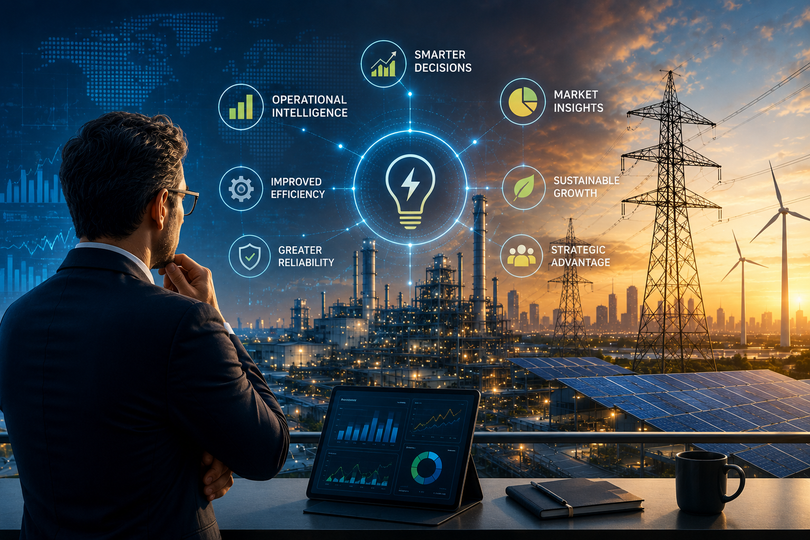
It is operational intelligence.
A gradual increase in energy consumption may indicate equipment beginning to lose efficiency. Variations between production lines may reveal maintenance opportunities. Building systems consuming more electricity than expected often reflect changing occupancy patterns rather than equipment failure. Electrical demand can even provide early indicators of production changes long before financial reports identify broader operational trends.
Viewed this way, electricity becomes much more than another utility.
It becomes another source of business insight.
That is one reason industrial organizations have invested heavily in technologies capable of consolidating operational information from across the enterprise. Production systems, maintenance platforms, building automation, environmental controls, electrical infrastructure, and financial reporting increasingly operate as connected information sources rather than independent systems.
Many organizations use an energy management system to support this integration. While these platforms certainly improve visibility into electricity consumption, their broader value lies in connecting energy information with production, maintenance, asset utilization, and operational performance. Instead of simply reporting historical consumption, they help organizations understand how energy supports the business itself.
The same evolution is taking place outside facility walls.
Businesses are recognizing that internal operational information becomes considerably more valuable when combined with external market intelligence. Organizations operating in Ontario increasingly monitor ieso market data (https://rodanenergy.com/ieso-market-data) to understand changing electricity demand, market conditions, and system activity. Internal data explains how a facility performs. External information explains the environment in which that facility operates.
Together, they provide a far more complete picture of operational performance.
This broader perspective is becoming increasingly important because the industrial economy itself continues changing.
Automation, artificial intelligence, electrification, advanced manufacturing, and digital infrastructure are all increasing dependence on reliable electrical systems. At the same time, executive leadership is expected to make larger investment decisions with greater confidence while responding to increasingly complex economic conditions.
Better information has therefore become one of the most valuable competitive advantages available.
Not because information replaces experience.
But because it strengthens it.
The organizations adapting most successfully are not necessarily collecting more information than everyone else.
They are learning how to ask better questions.
Asking better questions has become one of the defining characteristics of successful organizations. Rather than measuring only outcomes, businesses increasingly want to understand the conditions that produced those outcomes in the first place. Why did one production line outperform another despite using similar equipment? Why did maintenance costs increase while production remained stable? Why are some facilities consistently more efficient than others even though they were designed using nearly identical engineering standards?
The answers are rarely found within a single department.
Production data tells part of the story. Maintenance records explain another portion. Financial reporting provides additional context, while operational information gathered from electrical systems, automation platforms, building controls, and connected equipment often reveals relationships that would otherwise remain hidden. When those sources of information are brought together, organizations gain a much clearer understanding of how the business actually functions.
This is one of the most significant changes taking place across modern industry.
Operational visibility is replacing operational assumptions.
For decades, many decisions were based on historical experience because that was the best information available. Managers relied on periodic inspections, monthly reports, and personal observation to understand how facilities were performing. Those methods remain valuable today, but they are increasingly complemented by continuous operational intelligence that reflects conditions as they exist rather than as they existed several weeks earlier.
The difference is subtle, yet profoundly important.
Instead of responding after problems become visible, organizations are identifying opportunities while conditions are still developing. Equipment operating outside expected parameters can often be corrected before failures occur. Building systems consuming more electricity than necessary can be adjusted before utility costs begin affecting budgets. Production schedules can be refined using operational evidence rather than assumptions, while capital investments are increasingly supported by measurable asset performance rather than age alone.
The benefits accumulate over time.
Individually, many operational improvements appear relatively modest. A few percentage points of additional equipment efficiency. Slightly lower maintenance costs. Better utilization of electrical infrastructure. Improved production scheduling. More accurate capital planning. None of these changes transforms a business overnight, but together they create organizations that are more resilient, more productive, and better prepared to compete in increasingly demanding markets.
That cumulative effect explains why executive leadership has become more interested in operational intelligence than ever before.
Chief executive officers are expected to make strategic decisions that influence organizations for years into the future. Whether expanding manufacturing capacity, investing in automation, acquiring new facilities, or entering additional markets, those decisions depend upon understanding how existing operations actually perform. Reliable information reduces uncertainty, allowing leadership teams to invest with greater confidence while avoiding assumptions that may no longer reflect current operating conditions.
The role of engineering has also evolved.
Engineering teams continue designing, maintaining, and improving electrical infrastructure, but they increasingly contribute to broader business planning as well. Operational data collected through modern facilities provides insight that supports production, maintenance, sustainability, financial planning, and long-term growth strategies simultaneously. Engineering has become an important source of business intelligence because electrical infrastructure touches virtually every process within the organization.
Utilities are experiencing a similar transformation.
Electricity providers no longer rely exclusively on historical consumption when planning future infrastructure investments. Demand forecasting increasingly incorporates industrial development, commercial expansion, electrification, weather patterns, digital infrastructure, and broader economic activity. Better information allows utilities to prioritize investments more effectively while helping businesses plan future growth with greater certainty.
This growing reliance on operational intelligence has also increased the importance of specialized expertise.
Collecting information has become relatively straightforward. Interpreting it remains considerably more challenging. Industrial organizations generate millions of operational data points through automation systems, electrical infrastructure, environmental controls, production equipment, and maintenance platforms every day. Turning that information into meaningful operational improvements requires engineering knowledge, business understanding, analytical capability, and practical experience working across multiple industries.
For that reason, many organizations work with an experienced energy services company (www.rodanenergy.com) that understands how operational information can support broader business objectives. Rather than focusing exclusively on electricity consumption or engineering projects, these partnerships help businesses evaluate infrastructure readiness, identify operational trends, improve asset performance, and align energy strategy with long-term organizational goals. The value lies not simply in reducing operating costs, but in helping leadership teams make better-informed decisions supported by reliable operational evidence.
Looking ahead, the distinction between energy management and business management will continue narrowing.
Artificial intelligence will increase the volume of operational information available to organizations. Connected infrastructure will provide even greater visibility into facility performance, while automation will continue expanding throughout manufacturing, logistics, healthcare, commercial real estate, and countless other industries. Businesses capable of understanding these increasingly complex operating environments will make stronger investment decisions because they will possess a clearer understanding of how their organizations truly function.
The companies that lead the next decade are unlikely to be those simply investing in the newest technologies.
More likely, they will be the organizations that consistently transform information into action.
They will understand the relationship between electrical infrastructure and operational performance, between maintenance and productivity, between automation and long-term competitiveness. They will recognize that business intelligence does not originate exclusively from financial reporting or customer analytics. Increasingly, it comes from understanding how the organization itself operates every hour of every day.
Perhaps that is the most important lesson emerging from today’s industrial economy.
Energy is no longer simply something organizations purchase to power their facilities. It has become one of the richest sources of operational intelligence available to modern business. Every production process, every automated system, every connected asset, and every electrical measurement contributes another piece to a much larger picture describing how effectively an organization creates value.
The businesses that learn to interpret that picture will possess an advantage extending well beyond lower utility costs or improved engineering performance. They will develop greater operational clarity, stronger investment discipline, improved resilience, and a deeper understanding of the systems supporting their long-term success.
In many respects, that is the real energy transition taking place today. It is not only about cleaner electricity or modern infrastructure. It is about transforming operational information into better business decisions. Organizations that embrace that shift will be better equipped to compete in an economy where intelligence, adaptability, and informed decision-making have become every bit as valuable as the energy powering the facilities themselves.