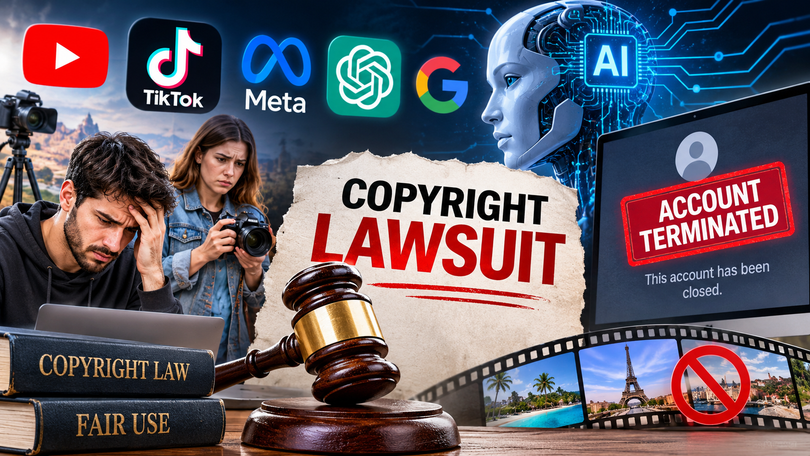

Creators, bloggers, and media outlets (including The New York Times, CNN and BBC) have filed massive class-action and individual lawsuits against major AI companies (such as OpenAI, Meta, TikTok Symphony, Google DeepMind and Gemini).
Plaintiffs argue that tech companies illegally copy, scrape, or pirate vast quantities of protected works into training datasets without permission or compensation, and that the resulting AI models create direct market competitors. Attorneys are investigating claims that videos were collected at scale and used to train AI models without creators’ consent. Law Firms stating that you were in the YouTube, TikTok or Meta Creators Program and have posted since 2019 or earlier, you could be entitled to significant compensation depending on the number of videos you have posted.
However, the most recent claims against Social Media AI platforms uncovered even more disturbing darker facts. Social Media giants such as TikTok, YouTube, and Meta not only used their bloggers’ videos (mostly videos produced by travel bloggers) to train and integrate in their AI programs but actively purged and terminated older creators’ accounts to cover up their mass piracy after using their intellectual property.
Several of those Social Media platforms moderators testified under oath that between 2024 and 2026 they were given a directive to abruptly terminate accounts of hundreds mid-size travel bloggers under false or made-up pretenses. Once the lawsuits started piling up, those giant platforms were afraid that bloggers would use their older videos as evidence of platforms mass privacy.
Platforms mostly scrapped older videos of travel bloggers because their videos were best fit to train their Artificial Intelligence. In order to cover up this mass piracy and exploiting those bloggers’ channels, moderators abruptly closed video creators accounts to remove all the evidence of their wrongdoings from the platforms.
Video platforms defend their practices by claiming AI training is “transformative”—that models analyze uncopyrightable patterns rather than copying expressions, which should be protected under fair use. A consensus among most legal observers: those technological giants engaged in unauthorized data acquisition and scraping (akin to mass digital piracy) rather than just the abstract concept of an AI “learning”. And after the new facts came to light showing that at least two major Social Media platforms were not only mass pirating their own creators’ videos for financial gain but also were terminating those creators’ blogs after using them to train their AI models, many more lawsuits are rightfully expected.